Experience mapping
If your client has a good customer journey map (including journeys relating to your desired outcome), you can use those to plot the 3 chosen possible product outcomes on, and to map out related opportunities later. Plotting the 3 chosen possible product outcomes on the customer journey helps us understand their context.
If there is no customer journey map, we create an assumptions based experience map around the product outcomes. An experience map is supposed to reflect what you currently know about your customer, so if it's assumption based, it will need to be verified.
You can use the experience map to guide you as you interview users to discover specific opportunities. Ask about things we're not sure about or that we're missing altogether. Keep updating your map as you learn more about users, so it will no longer be assumptions based. Keep in mind that ultimately it's not about the experience map itself, it's about the conversations it sparks.
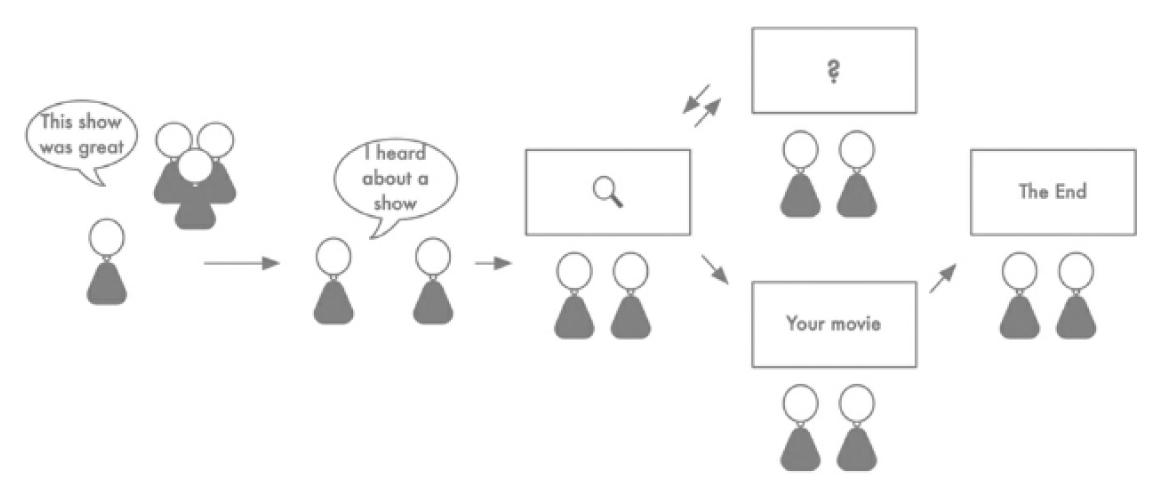
Workshop
This workshop takes no more than 2 hours.
We use Miro or FigJam for this workshop (templates are WIP).
Before the workshop, have the Product Trio individually map out their perspective on how the user moves toward the desired outcome(s) ("How do customers do [x]?"). In the workshop, we merge the different perspectives into one map.
Share [this video about 'wicked problems'](https://www.ted.com/talks/tom_wujec_got_a_wicked_problem_first_tell_me_how_you_make_toast?subtitle=en) with your Product Trio to prime them for experience mapping.
- Set the stage: do a check-in, do a quick recap of what was done recently, and a recap of why we are creating an experience map.
- Each participant shares their point of view – don't advocate for it, you're not trying to win. Other participants ask clarifying questions.
- As a group, collect all the nodes and links from all the individual maps into one map. First, cluster similar ones and create different stages of the experience, such as start, discover, learn, use, end. Remove true duplicates. Then, determine the links between all of the nodes to create possible paths a user might take.
- As a group, go over the map you just created. What are we missing? What is still unclear? What other questions pop up? Write down questions you want to discuss with others in the company, and/or in the upcoming user interviews.
Don't just map out the happy path. Capture where steps need to be redone, where people might give up out of frustration, or where steps might loop back on themselves.