Opportunity mapping w/ team
Workshop
This workshop takes up to 4 hours. You can split it up into several parts.
We use Miro or FigJam for this workshop (templates are WIP).
Introduction
- Set the stage: do a check-in, followed by a recap of Continuous Discovery (focus on opportunities, solutions, assumptions, and experiments), and a recap of the workshop we did with business stakeholders.
- Explain what we'll be doing in this workshop. By now you will have plotted the 3 selected product outcomes on your customer journey map / experience map, and you will have collected data to fill the funnels, and you will have compared and contrasted the product outcomes to find out which one will have the largest impact. By now you will also have collected several real opportunities. Maybe a few weeks have passed since the workshop with the business, and you've interviewed a few users. Or maybe the product team had already interviewed users before they started working with Hike One.
Opportunities
- Someone from the Product Trio presents the opportunities that have been identified through talking to users. Each opportunity is written down in the form of something a user literally says ("I want...", "I don't know...", "I have to..."). Others ask clarifying questions. In case any of the presented opportunities are assumptions, mark them as such – you will need to verify them before doing anything with them.
- Cluster opportunities in silence.
- As a group, go over each cluster. Are there parents and children? What makes most sense? Remember that nothing is set in stone. Grooming the tree is a recurring activity that helps the P3 understand the problem space.
- As a group, prioritise opportunities (from top to bottom) by assessing how many customers are impacted by it, how often, and how important it is to customers, and by discussing how addressing the opportunity might affect our position in the market, how well it fits with the company vision, mission and strategic objectives. Dot vote for each level, until you can choose one opportunity to brainstorm solutions for.
We don’t need to assess every opportunity on our tree. We can start by assessing the top row. Once we’ve identified our top priority in the top row, we can ignore the other branches of the tree (for now), and move to prioritising just that chosen opportunity’s sub-opportunities.
Solutions
- Each participant individually comes up with several potential solutions that fit the prioritised opportunity. These can become the product's pain relievers and gain creators.
- Each participant presents their solutions – no long stories, just describe in 1 or 2 sentences what the solution is. Other participants ask clarifying questions.
- Of all the solutions the participants generated, discuss which is most likely to deliver on the prioritised opportunity by comparing and contrasting them. Then dot vote to get to 3-5 solutions to list assumptions for.
Always only add solutions that fit with ONE specific opportunity (no duplicates in the tree). If a solution seems to address several opportunities, the solution is too broad. Break it up into parts. Keep in mind that we want to ship often and learn fast.
Assumptions
- Each participant individually writes down what we think we know about the 3-5 selected solutions the group came up with. What do we need to explore or validate about these solutions before we can decide which one to build? "This solution only works if..."
- Per solution, each participant presents their assumptions. Other participants ask clarifying questions.
- As a group, compare and contrast assumptions to determine which ones to test (first). Use the 2x2 grid of the amount of evidence we have to support the assumption vs how critical the assumption is for our solution to work. The ones that end up in the upper right quadrant move forward to the 'experiments' part of the workshop.
.png)
Experiments
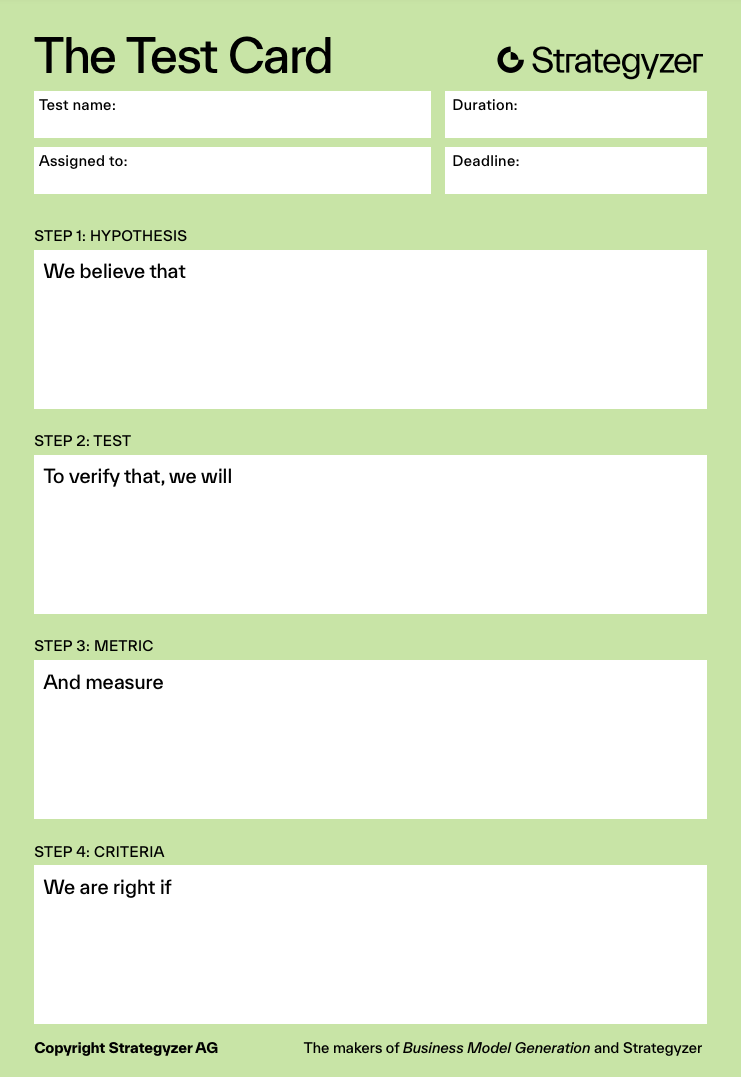
- Each participant individually thinks of ways to check if our riskiest assumptions are correct, by filling out test cards. All participants individually come up with at least one experiment.
- Each participant presents their experiment(s). Other participants ask clarifying questions. Then, we dot vote to select which ones we'll execute. As a group, we refine / complete the chosen experiment(s) so that the assigned person(s) can immediately start executing it after the workshop.
When selecting experiments, always judge them by how quickly they will deliver us valuable learnings. Which ones will decrease the risk inherent in building the solution? Which ones will provide just enough evidence for us to make sure we're building the right thing?